Vehicle Bug Out Bag: What Every Car Needs to Keep You Alive When the Road Goes Wrong

Why Most People Get This Wrong
Most people treat their car like a living room on wheels — comfortable, convenient, and completely unprepared for when things go sideways. They toss a dusty emergency kit from a big-box store under the seat, forget about it for three years, and call themselves prepared. They're not. That $19.99 kit with a mylar blanket the size of a napkin and four bandages isn't going to save you when you're stranded in a blizzard on a mountain pass or your engine dies twenty miles from nowhere in 100-degree heat.
Here are the most common mistakes people make with vehicle emergency kits — and why they'll get you killed:
- Buying a pre-packaged kit and never opening it. Most commercial kits are built to a price point, not a survival standard. The food is expired, the flashlight batteries are dead, and the first aid supplies are inadequate for anything beyond a paper cut.
- Treating the kit as a static item. Survival gear has seasons. What you need in January in Minnesota is not what you need in July in Arizona. Your kit must rotate with the climate.
- Keeping everything in one bag. If your trunk is inaccessible after an accident, or if someone breaks into your car and steals the bag, you have nothing. Layer your gear across multiple locations in the vehicle.
- Ignoring vehicle-specific tools. A bug out bag that ignores the vehicle itself — the thing keeping you mobile — is missing the entire point. If you can't get the car running again, or safely exit a bad situation, all the freeze-dried food in the world won't help you.
- Packing for a weekend camping trip instead of a genuine emergency. A vehicle BOB isn't about comfort. It's about keeping you functional, mobile, and alive until you reach safety.
The Fundamentals: Building Your Vehicle BOB the Right Way
Before you buy a single piece of gear, understand the mission. Your vehicle bug out bag has two jobs: keep you alive in or near the vehicle and keep you mobile and self-sufficient if you have to leave the vehicle on foot. Everything you pack must serve one of those two functions. If it doesn't, it's dead weight.
Follow this framework when building your kit:
- Assess your threat environment. Where do you drive? What are your most likely scenarios — winter storm, desert breakdown, flood, accident in a remote area? Build for what's real, not for Hollywood disasters.
- Think in time horizons. Your kit should sustain you for a minimum of 72 hours on foot or stationary. That's the baseline. If your commute or regular travel takes you through remote areas, plan for five to seven days.
- Distribute your gear strategically. Keep vehicle-specific tools (jumper cables, tow strap, tire repair) in the trunk or cargo area. Keep your personal survival bag — the one you grab on foot — in the passenger compartment or easily accessible.
- Prioritize the survival hierarchy. In order: shelter and warmth, water, signaling and communication, first aid, food, navigation, and self-defense. Pack accordingly, not by what's cheapest or easiest to find.
- Audit every six months. Spring and fall. Check expiration dates on food and medications. Swap out season-specific clothing. Test every piece of electronic gear. Replace anything that's been used or degraded.

What You Need: The Complete Vehicle BOB Gear Checklist
This is not a suggestion list. This is a working standard. Every item here has a specific purpose. Do not skip categories.
Vehicle Emergency Tools (Trunk/Cargo Area)
- Jumper cables — minimum 16-foot, 4-gauge copper clad
- Heavy-duty tow strap — 20-foot, rated 30,000 lbs minimum
- Tire plug and patch kit with portable air compressor (12V)
- Full-size spare tire (not a donut — know the difference)
- Lug wrench and breaker bar — not the cheap one that came with the car
- Fix-A-Flat (one can minimum, as a backup only)
- Folding shovel — entrenching tool style
- Traction boards or sand bags (critical in snow or soft terrain)
- Basic tool kit: pliers, adjustable wrench, screwdrivers, zip ties, duct tape, electrical tape, wire
- Two quarts of engine oil, one quart transmission fluid, coolant
- Waterproof matches or lighter for flares
- Road flares — 6 minimum, 30-minute burn time
- LED road triangles (3-pack) — reusable backup for flares
- Fire extinguisher — 2.5 lb ABC dry chemical, vehicle-mounted bracket
- Glass breaker and seatbelt cutter — within arm's reach of the driver, always
Shelter and Warmth
- Emergency mylar blankets — 2 per person (heavy-duty, not the foil paper kind)
- Wool or fleece blanket — one per person, stored in a compression bag
- Change of season-appropriate clothing in a dry bag — base layer, mid layer, outer shell
- Waterproof gloves and wool hat
- Waterproof poncho — one per person
- Hand warmers — 10 pairs minimum (HeatMax or similar, 12-hour rated)
- Small tarp — 8x10 ft with grommets and 50 feet of 550 paracord for improvised shelter
Water and Hydration
- Water — minimum one gallon per person stored in the vehicle (rotate every 6 months)
- Stainless steel water bottle — 32 oz, doubles as a pot for purification
- Water purification tablets — iodine or chlorine dioxide, 50-tablet pack
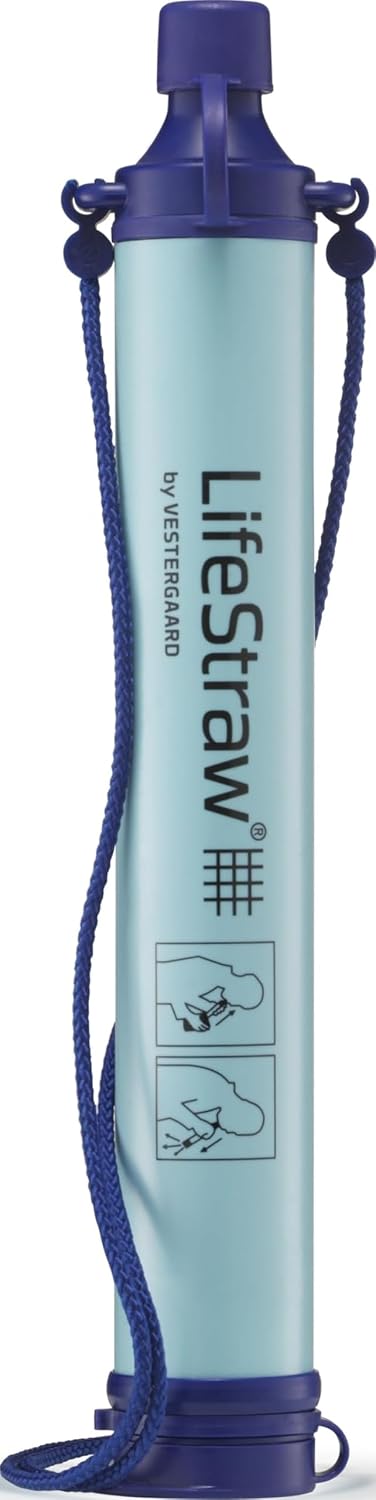
- Portable water filter — Sawyer Squeeze or LifeStraw type, rated 100,000 gallons
- Collapsible water container — 5-gallon for camp use or vehicle storage
Food
- High-calorie emergency ration bars — 3,600 calories minimum per person (Datrex or Mayday brand)
- Compact backpacking meals — 6 servings per person (Mountain House or Wise Company)
- Trail mix, hard candy, beef jerky — dense calorie snacks, 2-day supply per person
- Compact backpacking stove with fuel canisters — MSR Pocket Rocket or similar
- Spork and compact cooking pot
First Aid
- Comprehensive trauma kit — not a first aid kit, a trauma kit: tourniquet (CAT or SOFTT-W), chest seals, hemostatic gauze (QuikClot), Israeli bandages, compression bandages
- Standard first aid supplies: nitrile gloves (6 pairs), bandages, antiseptic wipes, blister treatment, moleskin, SAM splint
- Prescription medications — 7-day supply in original bottles
- OTC medications: ibuprofen, acetaminophen, diphenhydramine (Benadryl), antidiarrheal, antacid
- Medical shears
- CPR face shield
Navigation and Communication
- Paper maps — your state, your region, and every area you regularly travel
- Baseplate compass — Suunto A-10 or Silva Ranger type, know how to use it
- Handheld GPS — Garmin inReach Mini with satellite communication capability
- Hand-crank/solar emergency radio with NOAA weather bands
- Fully charged power bank — 20,000 mAh minimum with car charger cable
- Whistle — Fox 40 or ACME Tornado — carries 1/4 mile
Light and Signaling
- Headlamp — 300 lumen minimum with extra batteries
- Handheld flashlight — 1000 lumen, waterproof
- Signal mirror — military spec, 2x3 inch
- Chemlights (glow sticks) — 6 minimum, 12-hour rated
Advanced Tactics: What Separates the Truly Prepared
The gear list gets you in the game. These tactics keep you alive when everything goes wrong at once.
- Pre-plan your routes. Know at least two alternate routes from every location you frequent — home, work, kids' school. Mark fuel stops, water sources, and high ground on your paper maps. Don't rely on GPS when infrastructure is down.
- Cache critical supplies along regular routes. If you travel the same roads frequently, consider a small buried or secured cache at a mid-point. Even a waterproof ammo can with food, water, and a basic first aid kit can be the difference between making it and not.
- Keep your tank above half. Always. This single habit eliminates one of the most common survival failures. A full tank buys you distance, heat, and time. The habit costs nothing.
- Know your vehicle's capabilities and limitations. What's the max towing capacity? Approach and departure angles for off-road? Fuel range on a full tank? If you don't know these numbers, you'll make bad decisions under pressure.
- Build a dedicated grab-and-go bag for foot movement. If you have to abandon the vehicle, you need a bag you can grab in under 30 seconds that contains the essentials: water, filter, food for 72 hours, first aid, navigation, fire starting, and shelter. Keep it in the cab, not the trunk.
- Communicate your plan. Before any significant drive, someone who isn't with you should know your route, your destination, and your expected arrival time. Simple. Zero cost. Could save your life if you don't arrive.
- Train for the scenarios, not just the gear. A tourniquet in your bag does nothing if you've never practiced applying one under stress. Take a Stop the Bleed course. Practice navigation with map and compass. Changing a tire in the dark in the rain is a skill — practice it before you need it.

The Bottom Line: Action Steps to Take This Week
Stop reading and start building. Here's your action plan for the next seven days:
- Day 1: Open your current vehicle kit — or acknowledge you don't have one. Inventory what's there. Check expiration dates. Remove anything expired or non-functional. You may be starting from scratch, and that's okay.
- Day 2: Assess your threat environment. Write down the five most likely scenarios you could face based on your geography, climate, and daily routes. Build your list around those scenarios.
- Day 3: Source your vehicle tools and emergency equipment first — jumper cables, tow strap, tire repair, fire extinguisher, glass breaker. These keep you mobile. Mobility is survival.
- Day 4: Build or upgrade your trauma kit. Order a CAT tourniquet, QuikClot gauze, and chest seals if you don't have them. Then take a Stop the Bleed class — they're free in most areas.
- Day 5: Source your shelter and water supplies. One gallon of water minimum, a quality filter, a wool blanket, and season-appropriate clothing get packed today.
- Day 6: Pull your paper maps and mark your routes, alternates, and key waypoints. Download offline maps on your phone as a backup. Test your communication devices.
- Day 7: Consolidate everything. Distribute gear strategically in your vehicle — heavy vehicle tools in the trunk, grab-and-go bag in the cab. Label everything. Set a calendar reminder six months out to audit and rotate.
Your vehicle is either a survival asset or a liability. The difference is the thirty minutes it takes to prepare it properly. You don't get a warning when things go wrong. The time to build this kit is not when you need it — it's right now, while you have the luxury of choice.
🛒 Essential Survival Gear
As an Amazon Associate I earn from qualifying purchases.