Ranked & Ruthless: The Best Water Filtration Methods When Your Life Depends On It

The Reality Most People Ignore
It's day three after the grid goes down. The faucet runs dry. Your neighbor is already sick from drinking untreated creek water, and you're watching your family's water supply dwindle to nothing. This is not a hypothetical. It happened in Puerto Rico after Hurricane Maria. It happened in Flint. It happened to thousands of people during the Texas winter storm of 2021 — regular families, not unprepared people, just people who never thought it would happen to them.
Water is the single most critical survival resource you will ever manage. You can survive three weeks without food. You will not survive three days without water. And yet, the vast majority of preppers spend thousands on firearms, freeze-dried meals, and bug-out bags while their water plan amounts to a single Brita filter and a vague intention to "find a stream." That is not a plan. That is a death sentence written in comfortable ignorance.
The hard truth is this: contaminated water kills faster and more reliably than almost any other survival threat you'll face. Waterborne pathogens like Giardia lamblia, Cryptosporidium, E. coli, and cholera-causing bacteria don't care how tough you are or how much ammo you've stockpiled. They will drop you — and your children — within days. Your water filtration plan needs to be layered, redundant, and deeply understood. Not skimmed. Not assumed. Mastered.
Core Principles and Knowledge Breakdown
Before we rank filtration methods, you need to understand what you're actually filtering. Waterborne threats fall into three main categories, and not every filtration method handles all three:
- Protozoa — Giardia, Cryptosporidium. Large microorganisms, relatively easy to filter mechanically.
- Bacteria — E. coli, Salmonella, Cholera. Smaller than protozoa, require finer filtration or chemical treatment.
- Viruses — Hepatitis A, Norovirus, Rotavirus. Extremely small. Most mechanical filters do NOT remove viruses. This is the gap most preppers don't know exists.
- Chemical and heavy metal contamination — Requires activated carbon or reverse osmosis. No survival straw handles this effectively.
This is the knowledge gap that gets people killed. Someone uses a LifeStraw in a developing country or a post-flood environment where viral contamination is high, feels confident, and still gets sick. Know your threats, then choose your tools. Now, let's rank your options — from most reliable to least — across four critical factors: pathogen coverage, ease of use, long-term viability, and failure resistance.

The Ranked Methods — Reliability Under Pressure
Tier 1 — Boiling Water
This is still the gold standard, and it has been for ten thousand years. Boiling water at a rolling boil for one minute (three minutes above 6,500 feet elevation) kills protozoa, bacteria, and viruses with complete reliability. No batteries. No filters to clog or replace. No proprietary cartridges. Just fire, a metal container, and water. Every single prepper alive should have this as their foundational skill and their fallback position when everything else fails. The downsides? It requires fuel, time, and fire — three things that may be limited in certain scenarios. It also does nothing for chemical contamination. But as a pathogen killer, nothing beats it for simplicity and absolute reliability.
Tier 2 — Gravity Filters with Ceramic or Hollow Fiber Elements (Berkey, Sawyer, Platypus GravityWorks)
A quality gravity-fed system like the Big Berkey is the backbone of any serious home water prep. These systems use ceramic or hollow fiber membranes with pore sizes small enough to block protozoa and bacteria down to 0.1 or 0.2 microns. The Big Berkey, when equipped with Black Berkey elements, also removes heavy metals, pharmaceuticals, and many chemical contaminants. It requires no power, no pumping, and can process large volumes over time. For a homestead or shelter-in-place scenario, this is your workhorse. Limitation: most hollow fiber filters still don't reliably eliminate viruses unless specifically rated as such. In a domestic US emergency with a clean water source that's simply been compromised by flooding or infrastructure failure, this is usually acceptable. In a post-collapse sanitation breakdown or international scenario, add a chemical purification step.
Tier 3 — Chemical Purification (Iodine, Chlorine Dioxide, Aquatabs)
Chlorine dioxide tablets like Katadyn Micropur or Potable Aqua ARE effective against viruses, bacteria, and protozoa — including Cryptosporidium, which regular iodine or chlorine bleach does not reliably kill. This makes chlorine dioxide uniquely valuable. Tablets are lightweight, cheap, and last for years when stored properly. They are your answer to the viral contamination gap left by mechanical filters. The cons: they take 30 minutes to four hours to work depending on the pathogen and water temperature, they leave a slight taste, and they don't address sediment or chemical contamination. Stack these with a mechanical filter for a complete system. Use the filter first to remove sediment and protozoa, then treat with chlorine dioxide for full-spectrum coverage.
Tier 4 — Pump and Squeeze Filters (Katadyn Hiker Pro, Sawyer Squeeze, MSR Guardian)
For the bug-out bag and field use, portable mechanical filters are essential. The Sawyer Squeeze is lightweight, filters down to 0.1 microns, and is rated for up to 100,000 gallons. The MSR Guardian is the heavyweight champion of field filters — it filters viruses as well, making it one of the few mechanical filters that provides true full-spectrum protection. Yes, it's expensive at over $350. It's also used by military units and wilderness medical professionals. Your budget determines your tool here, but understand the difference between what a $30 squeeze filter handles and what a Guardian handles. For domestic wilderness emergencies, the Sawyer is exceptional. For international travel, post-pandemic scenarios, or serious SHTF environments, invest in viral coverage.
Tier 5 — UV Purification (SteriPen, UV water bottles)
Ultraviolet light disrupts the DNA of pathogens and renders them unable to reproduce. A SteriPen, used correctly in clear water, is effective against viruses, bacteria, and protozoa. The critical word is clear. Turbid or cloudy water blocks UV light, dramatically reducing effectiveness. Always pre-filter through a bandana, coffee filter, or mechanical filter before using UV treatment. UV devices also require batteries or charging — in a long-term grid-down scenario, this is a liability. Great as a backup tool, not a primary system.
Tier 6 — Survival Straws (LifeStraw, basic inline filters)
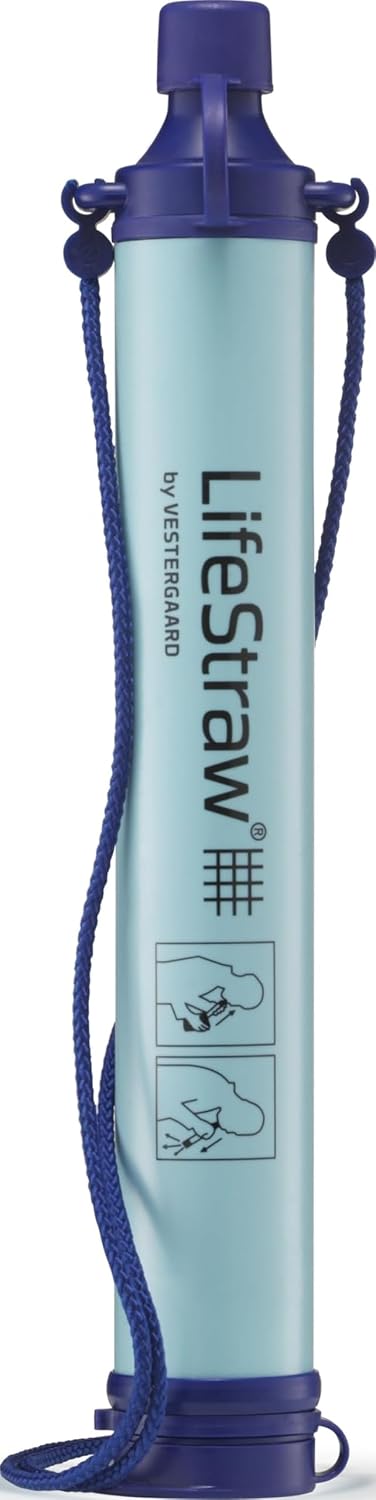
LifeStraw is a marketing masterpiece and a legitimate life-saving tool in acute emergencies. It filters protozoa and bacteria effectively. It does not filter viruses. It does not allow you to store treated water — you drink directly through it. It has a limited lifespan of about 1,000 gallons. It is a last-resort tool, not a primary survival strategy. Keep one in every bug-out bag and every vehicle kit. Understand its limitations. Never rely on it as your only plan.
Building This Into Your Prep Plan
Redundancy is the prepper's religion, and nowhere is it more important than water. Here is the layered system every serious prepper should have in place:
- Storage first. Minimum one gallon per person per day, two weeks minimum, one month preferred. FEMA says three days. Serious preppers say 30. WaterBOB bathtub bladders and 55-gallon food-grade barrels are your best bulk storage options.
- Primary home filtration. A gravity-fed ceramic or Black Berkey system capable of processing your household's daily needs without power or pressure.
- Chemical backup. A six-month supply of chlorine dioxide tablets. They store for years, weigh nothing, and fill the viral gap.
- Field and bug-out filtration. A Sawyer Squeeze or MSR Guardian in every bug-out bag. A backup LifeStraw in every vehicle.
- Knowledge of boiling. This costs nothing and works forever. Practice it. Time it. Own it.
Also understand your local water sources. Do you know where the nearest creek, river, or lake is from your home? Do you know what's upstream from it — farms, industrial sites, septic systems? Map your water sources now, while you have time to think clearly. Under stress, people make terrible decisions. Under preparation, they make good ones automatically.

Advanced Level — What Serious Preppers Do Differently
The serious prepper doesn't just stockpile gear. They test it, practice with it under pressure, and build systems that function without them — because in a real emergency, you might be injured, sick, or unavailable to manage the process.
Serious preppers do these things most people skip:
- They test their filters with turbid water. Fill a bucket with creek water, mud it up, and run it through your system. Know how your filter performs under realistic conditions, not tap water in your kitchen.
- They maintain filter elements. Backflush Sawyer filters regularly. Replace Berkey elements on schedule. A clogged or degraded filter gives you false confidence — the most dangerous kind.
- They train their family. Your spouse and your teenager need to be able to operate the filtration system without you. Hold a family water drill. Make it real.
- They consider rainwater harvesting. A properly designed rainwater collection system on your home or homestead can provide a self-replenishing water source. In many US states this is legal and increasingly common. First-flush diverters and proper storage tanks make the water quality dramatically better before it ever reaches a filter.
- They store knowledge, not just gear. A printed copy of the FEMA water purification guidelines, the CDC's waterborne illness identification guide, and a wilderness medicine manual belong in every serious prep library. When your phone is dead, your books still work.
- They understand that water is a community asset. In a long-term scenario, the family or group that controls and can safely provide clean water has enormous security and community value. This is not just a survival skill. It's a leadership skill.
Your Action Plan — What to Do in the Next 30 Days
Reading is not prepping. Action is prepping. Here is your 30-day water security challenge. Execute it. No excuses.
- Week 1: Audit your current water storage. How many gallons do you have? For how many people? For how many days? Close the gap. Order WaterBOBs or food-grade storage containers today. Begin filling.
- Week 1: Order a two-year supply of chlorine dioxide tablets. Katadyn Micropur or Potable Aqua with PA Plus. Store them with your emergency kit, your bug-out bag, and your vehicle. This is a $40 decision that might save your life.
- Week 2: Purchase or evaluate your primary home filtration system. If you don't own a quality gravity filter, this is your most important purchase. Research the Big Berkey, the Alexapure Pro, and comparable systems. Buy the best you can afford.
- Week 2: Add a Sawyer Squeeze or MSR Guardian to every bug-out bag in your household. Add a LifeStraw as backup. Know the difference between them and know when to use each.
- Week 3: Practice boiling water under field conditions. Build a fire outside. Boil a pot of water to drinking temperature. Time it. Do it with your kids so they can do it without you.
- Week 3: Map your local water sources within a five-mile radius. Identify what's upstream. Research your local watershed and any known agricultural or industrial contamination points. This knowledge is invisible armor.
- Week 4: Run a family water drill. Simulate a 72-hour water emergency. Turn off your water at the main valve on a Saturday morning and run your family through the full system — storage access, filtration, boiling, and chemical treatment. Identify weaknesses before they identify you.
- Week 4: Add a printed water purification reference to your emergency binder. Print it. Laminate it. File it. Store it where your family can find it without power, without internet, and without you.
The Bottom Line
Every system fails. Filters clog. Tablets run out. Batteries die. Fires go out in the rain. The only thing that never fails is a prepared mind — a person who has thought through the scenarios, built the redundancy, practiced the skills, and trained their family to execute without panic. Water is not a survival afterthought. It is the foundation that every other prep is built on. When you take water seriously, you take your family's survival seriously.
The grid will fail. The taps will run dry. The question is never if — it's whether you'll be ready when it happens. Build your water system now, while you still have the luxury of time. Because when you need it, there won't be any time left to prepare.
🛒 Essential Survival Gear
As an Amazon Associate I earn from qualifying purchases.