Grid-Down Survival: What You Must Do in the First 72 Hours

Why Most People Get This Wrong
The average American household has less than three days of food on hand and no reliable water storage plan. When the grid goes down — whether from a cyberattack, extreme weather, EMP, or infrastructure failure — most people spend the first six hours in denial and the next eighteen in panic. That window costs them everything.
Here are the most common and most dangerous mistakes people make in the first 72 hours of a grid-down event:
- Assuming it's temporary. Most people treat every outage like a thunderstorm. They sit on the couch, wait it out, and drain their phone battery watching for updates. When day two hits and nothing has changed, they're already behind the curve with no plan and depleted resources.
- Rushing to the store. Within two hours of a major grid failure, grocery store shelves are stripped. ATMs are offline. Card readers don't work. If you're running to the store, you're already too late — and now you're in a crowd of desperate people.
- Ignoring water immediately. People think about food first. Wrong. You can survive three weeks without food. You will be in serious medical trouble in three days without water. The moment the grid goes down, your municipal water system is on borrowed time. Most water treatment facilities have 24–72 hours of backup generator fuel. After that, pressure drops and contamination risk spikes.
- Burning through fuel without a plan. Running your generator non-stop to keep the fridge cold burns through 10–20 gallons of gas per day. Without a rationing plan, you're out of fuel before you're out of the emergency.
- Failing to communicate and coordinate. People scatter. Family members are at work, school, or across town. Without a pre-established communication plan and rally point, you waste critical time and fuel trying to locate people instead of executing your survival plan.
The Fundamentals: Hour-by-Hour for the First 72
When the power goes out and it's clear this isn't a routine blip, you move through four priority phases: Assess, Secure, Sustain, and Adapt. Here's how that breaks down in real time.

Phase 1 — Hours 0 to 6: Assess and Activate
- Confirm the scope. Check your neighbors. Check a battery-powered or hand-crank radio (NOAA Weather Radio, AM/FM). Determine if this is local, regional, or national. Your response scales with the scope.
- Fill every water container immediately. Bathtubs, pots, jugs, WaterBOB bladders — everything. Do this within the first 30 minutes. If municipal water fails, you want every container you own topped off. Fill your bathtub with a WaterBOB (holds up to 100 gallons) if you have one. If not, use what you have.
- Account for all family members. Activate your communication plan. Designate one out-of-area contact everyone checks in with. If cell towers are overwhelmed, text messages often go through when calls won't.
- Secure your home. Lock doors and windows. Stage your defensive tools. In a grid-down scenario, security threats escalate faster than most people expect — typically within 24–48 hours in urban and suburban areas.
- Inventory your resources. Food, water, fuel, medications, first aid supplies. Know exactly what you have before you start consuming it. Write it down.
Phase 2 — Hours 6 to 24: Secure Your Water Supply
- Calculate your water needs. Plan for a minimum of 1 gallon per person per day for drinking and basic sanitation. For a family of four over 72 hours, that's a minimum of 12 gallons — more if you have medical needs, infants, or pets.
- Protect what you've stored. Keep filled containers away from sunlight and in a cool location. Label containers with fill date.
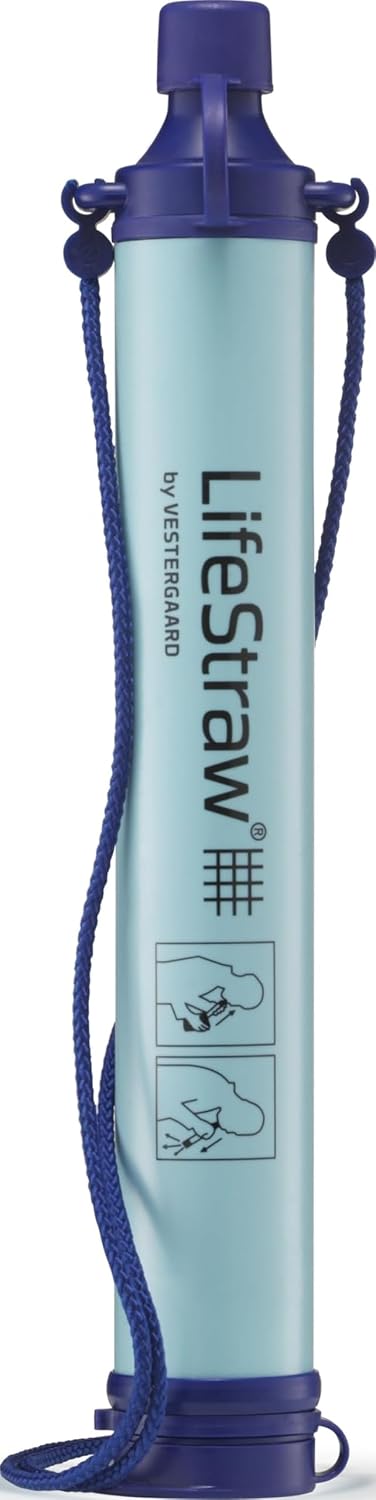
- Set up your water purification system. If stored water runs out, you need a backup. A gravity filter like the Berkey (Big Berkey handles 2.25 gallons, Black Berkey filters last 3,000 gallons each) is ideal for home use. Life Straw or Sawyer Squeeze filters work for on-the-go. Stock unscented liquid bleach (8.25% sodium hypochlorite) — 8 drops per gallon to treat clear water, 16 drops for cloudy water. Let stand 30 minutes before drinking.
- Identify secondary water sources. Know where the nearest natural water source is — streams, rivers, ponds. Know how to get there and how to treat what you collect.

Phase 3 — Hours 24 to 48: Food, Fuel, and Sanitation
- Eat perishables first. Your refrigerator maintains safe temps for about 4 hours without power (keep the door closed). Your freezer holds for 24–48 hours if full and unopened. Eat fresh and refrigerated food first, then freezer items, then shelf-stable supplies.
- Establish a cook plan. A propane camp stove with two 1-lb canisters or a single 20-lb tank connected with an adapter gives you multiple days of cooking. A rocket stove or wood-burning stove using hardwood or biomass is a renewable option. Never use indoor cooking equipment outside its intended environment — CO poisoning kills in minutes.
- Manage generator fuel ruthlessly. Run your generator 2–3 hours, twice per day — enough to keep a chest freezer at safe temps. Pre-treated fuel stored in approved containers (5-gallon Jerry cans with Sta-Bil added) stays viable for 12–24 months.
- Plan for sanitation. When water pressure drops, toilets stop working reliably. Keep a 5-gallon bucket, heavy-duty trash bags, kitty litter or sawdust, and a toilet seat adapter. Human waste disposal becomes a critical hygiene and health issue by day two.
Phase 4 — Hours 48 to 72: Decide — Shelter in Place or Move
- Re-assess the situation. By 48 hours, you have real information. Is civil order holding? Are stores restocked? Is power coming back? Or is this a longer-term event?
- Evaluate your location security. If social order is deteriorating, your home's defensibility matters. Reinforce entry points. Establish a watch schedule. Limit light signature at night — blackout curtains or heavy blankets over windows.
- Make the bug-out/bug-in decision with hard criteria, not emotion. Bug out only if staying becomes more dangerous than moving. The road is not a safe place in a prolonged grid-down event. If you go, go early — before fuel runs out and roads gridlock.
What You Need: The 72-Hour Grid-Down Checklist
If you don't have these items staged and ready, you're reacting instead of executing. Build this kit now.
Water
- Minimum 1 gallon per person per day stored (target: 2 weeks minimum)
- WaterBOB bathtub bladder (100-gallon capacity, under $30)
- Gravity water filter — Big Berkey or equivalent
- Sawyer Squeeze or LifeStraw for portable filtration
- Unscented liquid bleach (8.25% sodium hypochlorite) — 1-gallon jug, rotated annually
- Water storage containers — 5-gallon BPA-free jugs with spigots
Food
- 72-hour minimum: 2,000 calories per person per day
- Canned goods, freeze-dried meals, rice, beans, oats — all with a 5+ year shelf life
- Manual can opener (have two)
- Propane camp stove + minimum four 1-lb canisters or one 20-lb tank
Power and Light
- Battery-powered or hand-crank NOAA weather radio
- Headlamps with extra batteries (lithium, not alkaline — they perform in cold and last longer)
- 12V car battery jump pack with USB ports for device charging
- Generator with 10–15 gallons of pre-treated fuel stored safely outdoors
Medical and Sanitation
- 30-day supply of all prescription medications
- Comprehensive first aid kit: Israeli bandages, tourniquets (CAT or SOFTT-W), QuikClot gauze, nitrile gloves, SAM splints, oral rehydration salts
- Sanitation kit: 5-gallon bucket, toilet seat lid, heavy-duty bags, kitty litter, hand sanitizer
Communication and Navigation
- Printed contact list and rally point instructions — stored in a waterproof bag
- GMRS or FRS radios for local communication (BaoFeng UV-5R for longer range with licensing)
- Paper maps of your local area and bug-out routes
Advanced Tactics: What Separates the Prepared from the Prepared
Getting through 72 hours alive is the baseline. Thriving through a prolonged grid-down event requires a different level of preparation. These are the tactics most preppers don't implement until it's too late.
- Faraday cage protection. If the event is EMP-related, unprotected electronics are gone. Store backup radios, solar chargers, and critical electronics in a lined metal trash can with a tight-fitting lid and rubber gasket — a functional faraday cage for under $40.
- The gray man principle. During a grid-down scenario, advertising your preparedness makes you a target. Don't run your generator loudly, don't cook fragrant food near open windows, and don't discuss your supplies with neighbors who aren't part of your trusted group.
- Mutual aid network. A group of six to ten trusted households with complementary skills — medical, mechanical, security, agricultural — is exponentially more resilient than any single family. Build those relationships before the emergency.
- Skill redundancy. Every adult in your household should know how to purify water, treat a wound, navigate with a map and compass, and operate every piece of your gear. Skills don't run out of batteries. Take a Stop the Bleed course. Take a wilderness first aid course. Practice with your gear quarterly.
- Financial liquidity. Keep $200–$500 in small bills in a fireproof safe at home. In a grid-down scenario, electronic payments fail. Cash, barter goods (coffee, alcohol, ammunition, medications), and useful skills become your currency.
- Layered security posture. Layer one is deterrence — don't look like a target. Layer two is detection — motion-activated solar lights, dogs, simple trip-wire alerts. Layer three is response — you and your group, trained and equipped. Security is a system, not a single tool.
The Bottom Line: Actions to Take This Week
Reading this is worthless if you don't act. Here's your assignment for the next seven days:
- Day 1: Calculate your household's 72-hour water requirement and fill that number in containers today. Order a WaterBOB if you don't have one.
- Day 2: Audit your food supply. Count calories, not just cans. Identify the gaps. Write a shopping list.
- Day 3: Write a one-page family communication and rally point plan. Print two copies. Give one to every family member. Store one in each vehicle.
- Day 4: Test your gear. Run your generator. Use your camp stove. Filter water with your Berkey or Sawyer. If something doesn't work, you want to find out now.
- Day 5: Inventory your first aid kit. Replace anything expired. If you don't have a tourniquet and know how to use it, order one and watch a TCCC application video today.
- Day 6: Identify two trusted neighbors or family members for a mutual aid conversation. You don't need to call it a prepper group. Call it a neighborhood watch or emergency plan. Start the conversation.
- Day 7: Locate your area's NOAA weather radio frequencies and nearest natural water sources. Mark them on a paper map. Store that map somewhere accessible.
The grid will fail again — the only question is whether you'll be ready when it does.
🛒 Essential Survival Gear
As an Amazon Associate I earn from qualifying purchases.